How Does BPD Compass Treat Borderline Personality Disorder?
A Personalized, Evidence-Based Treatment for Borderline Personality Disorder
The treatment landscape for borderline personality disorder (BPD) has changed dramatically over the past few decades. A condition that was once considered a life sentence is now recognized as one of the most treatable disorders in psychiatry. Several evidence-based interventions, including dialectical behavior therapy (DBT), mentalization-based therapy (MBT), transference-focused psychotherapy (TFP), and good psychiatric management (GPM), have consistently been shown to reduce symptoms and improve functioning.
One of the newest additions to this growing list of treatments is BPD Compass, a modular intervention designed to personalize treatment based on the personality processes driving an individual's symptoms. In an initial randomized controlled trial, participants receiving BPD Compass experienced significant improvements in BPD symptoms, depression, anxiety, and the personality traits associated with the disorder after just 18 sessions of once-weekly outpatient therapy.
So, what exactly is BPD Compass, and how is it different from existing treatments?

Why Was BPD Compass Developed?
Although existing treatments for BPD are highly effective, they can be difficult to access. Most of the best-studied interventions were originally developed for individuals at the highest levels of clinical need and therefore tend to be long-term, intensive, and delivered by clinicians with specialized training. These programs remain critically important, particularly for individuals experiencing chronic suicidal thoughts or behaviors.
At the same time, access to this level of care remains a challenge. Many specialty programs have waitlists that stretch six months to a year or longer, and some communities have few clinicians trained to provide evidence-based treatment for BPD. For many people, the biggest obstacle isn't deciding which treatment to pursue. It's finding any treatment at all.
There is another challenge as well. BPD is one of the most heterogeneous disorders in psychiatry. In fact, there are 256 different combinations of symptoms that can result in the diagnosis. Two people may both meet criteria for BPD while sharing only a handful of symptoms. One person may be primarily overwhelmed by intense emotions, another may struggle most with unstable relationships, and a third may be derailed by impulsive behaviors that interfere with work, school, or family life.
Together, these two realities—limited access and tremendous variability in symptom presentation—raise an important question: Can treatment be both more personalized and more efficient?
Why Personalization Matters
Historically, most treatments for BPD have taken a comprehensive approach by teaching all clients the same core set of skills. There are good reasons for this. Because BPD can affect so many different areas of functioning, clinicians want to ensure that people leave treatment with a broad toolkit.
But comprehensive doesn't always mean personalized.
Imagine two people who both struggle with impulsive spending. On the surface, the behavior looks identical. Yet one person shops to escape overwhelming sadness or anxiety, while the other is driven by the excitement of making a purchase in the moment (or just not thinking about the consequences). The behavior is the same, but the psychological processes maintaining it are different. Treating both individuals exactly the same may overlook what is actually keeping the behavior going.
This principle extends far beyond impulsive spending. Someone who frequently argues with their partner may respond to deeply held beliefs that others can’t be trusted or have malicious motives. Another person may avoid closeness altogether because emotional vulnerability feels unsafe. Although all of these difficulties fall under the umbrella of BPD, they are unlikely to respond best to identical interventions.
How Does BPD Compass Work?
BPD Compass was developed with the idea that treatment should target the processes maintaining each person's symptoms rather than assuming every client needs the same skills in the same order.
The treatment is grounded in the Alternative Model of Personality Disorders (AMPD), a contemporary framework that conceptualizes personality disorders in terms of maladaptive personality traits rather than symptom counts alone. This model reflects a growing consensus among personality researchers that understanding why symptoms occur is just as important as identifying which symptoms someone experiences.
From this perspective, many features of BPD emerge from three broad personality-based risk factors: emotional sensitivity, interpersonal dysfunction, and impulsivity. Although most people with BPD experience challenges in each of these areas to some degree, one or two domains often play a larger role in maintaining their symptoms.
Treatment begins with a comprehensive assessment to identify which of these processes are most central for the individual. Therapists then select treatment modules that directly target those mechanisms. Rather than teaching every client every possible skill, treatment focuses on the areas most likely to produce meaningful change.
What Happens During Treatment?
Like other evidence-based treatments, BPD Compass begins with a thorough assessment. Beyond understanding symptoms, therapists work collaboratively with clients to clarify their values and identify the kind of life they want to build. This provides a roadmap for treatment by ensuring that therapy is aimed at helping people move toward something meaningful, not simply away from distress.
As treatment progresses, clients learn practical cognitive-behavioral strategies tailored to their particular pattern of difficulties. Depending on the person, this might include learning to experience emotions without avoiding them, improving communication and relationship skills, reducing impulsive behaviors, or testing long-standing beliefs through behavioral experiments.
The treatment also emphasizes practicing these skills in everyday life. Like any new habit, personality change happens through repetition. Each time someone responds differently to a challenging situation, they gather evidence that new ways of thinking and behaving are possible.
How Is BPD Compass Different from DBT?
People often ask whether BPD Compass is intended to replace DBT. The answer is no.
DBT remains one of the most extensively researched treatments for BPD and continues to be an excellent option, particularly for individuals at high risk for suicide or severe self-harm. BPD Compass was developed to address a different clinical need.
Whereas DBT follows a comprehensive skills curriculum, BPD Compass uses a modular format that allows treatment to be tailored to the client's primary difficulties. It also fits within an 18-session, once-weekly outpatient model and was designed to be delivered by generalist clinicians, as well as specialists.
Rather than competing approaches, these treatments expand the menu of evidence-based options available to clinicians and patients. As our understanding of BPD grows, having multiple effective treatments increases the likelihood that people can find care that matches both their clinical needs and the resources available in their community.
Why Generalist Clinicians Matter
One of the goals of BPD Compass is to increase access to effective treatment. There are simply not enough BPD specialists to meet the needs of the millions of people living with this diagnosis. Even in large metropolitan areas, waitlists for specialty programs can be months long.
For that reason, BPD Compass was intentionally designed to be delivered by clinicians without extensive prior experience treating BPD. In the initial clinical trial, many of the therapists were trainees rather than seasoned specialists. The treatment was structured to provide enough guidance that generalist clinicians could deliver it effectively while still allowing flexibility to personalize care.
Expanding the number of clinicians who feel confident treating BPD has the potential to improve access while preserving intensive specialty programs for individuals who require the highest levels of care.
What Does the Research Show?
The initial randomized controlled trial of BPD Compass found significant improvements in BPD symptoms, depression, anxiety, and the personality traits associated with the disorder. Participants also reported high satisfaction with treatment, suggesting that a personalized, modular approach was both effective and acceptable.
As with any emerging treatment, additional research is needed. Future studies will compare BPD Compass directly with other evidence-based interventions, examine which patients benefit most from this approach, and continue refining methods for matching treatment to individual needs.
The Future of BPD Treatment
The goal of BPD Compass has never been to replace DBT, or any other evidence-based treatment for BPD. Each of these interventions has transformed the lives of countless people and remains an important part of the treatment landscape.
Instead, BPD Compass reflects a broader shift occurring throughout mental health care. As researchers learn more about personality and psychopathology, treatment is becoming increasingly personalized. Rather than asking which therapy is universally best, clinicians are beginning to ask which evidence-based treatment is the best fit for this individual?
That shift has the potential to make treatment not only more effective, but also more accessible. For people living with BPD, that's encouraging news. Recovery is no longer a question of whether effective treatments exist. Increasingly, the challenge is making sure the right treatment reaches the right person at the right time.
Frequently Asked Questions
Is BPD Compass evidence-based?
Yes. BPD Compass has been evaluated in a randomized controlled trial, in which participants experienced significant improvements in BPD symptoms, depression, anxiety, functioning, and personality traits following the intervention. As with any newer treatment, additional studies are underway to replicate and extend these findings. Our team currently has funding from the National Institute of Mental Health (NIMH) to continue to refine our treatment personalization procedures. Interested in the research behind this approach? Visit the my research lab’s websiteto explore our publications.
Is BPD Compass a type of cognitive behavioral therapy?
Yes. BPD Compass is grounded in cognitive behavioral principles and incorporates behavioral experiments, cognitive interventions, exposure-based strategies, and skills training. It also integrates elements from relational treatments. What distinguishes BPD Compass is not the therapeutic techniques themselves, but the way treatment is personalized to target the personality processes maintaining each person's symptoms.
How Can I Access BPD Compass?
There are several ways to engage with the BPD Compass approach, depending on your needs.
If you're looking for a self-guided option, The BPD Compass Workbook walks you through the same personalized framework used in treatment and can be completed independently.
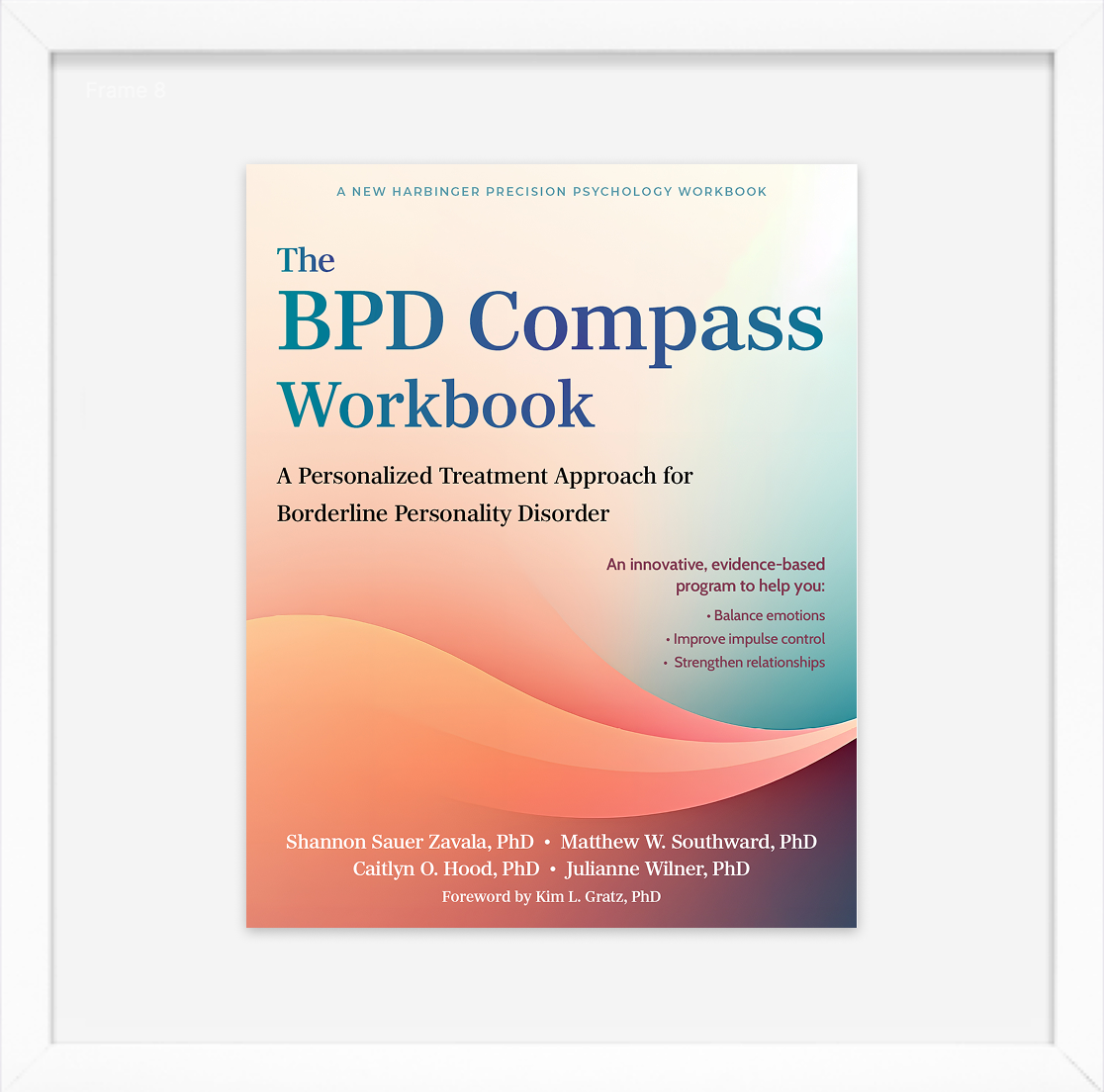
BPD Compass Workbook Cover
If you're already working with a therapist, you can bring The BPD Compass Workbook to your sessions and use it together as a guide for treatment. Because it was designed with generalist clinicians in mind, therapists do not need years of specialized BPD training to incorporate many of its concepts into their work.
If you're interested in receiving BPD Compass directly, you can also learn more about the clinical services offered through my practice to see whether our approach is a good fit for your needs.
Can I Use The BPD Compass Workbook Without a Therapist?
Yes.The BPD Compass Workbook was written so individuals can work through the exercises independently. However, many readers also choose to use the workbook alongside their therapist, allowing them to personalize treatment together. Because the approach was designed with generalist clinicians in mind, therapists do not need extensive prior experience treating BPD to begin incorporating many of its concepts into their work.
How long does BPD Compass take?
The full BPD Compass program consists of 18 once-weekly outpatient sessions, allowing most people to complete treatment in approximately five months. During that time, clients work through modules targeting emotional sensitivity, relationship difficulties, and impulsivity.
More recently, our research team has begun studying an even more personalized version of the treatment. Rather than completing all three modules, participants receive only the module targeting their greatest area of difficulty. In this study, treatment lasts just eight sessions, and many participants have experienced meaningful improvement in that shorter time frame.
BPD Compass was intentionally designed to fit within the type of therapy most people receive in routine outpatient practice.
Who can provide BPD Compass?
One of the goals of BPD Compass is to make evidence-based treatment available to more people by expanding the number of clinicians who feel confident treating BPD. Rather than requiring years of specialty training, the treatment was designed for both specialists and generalist therapists working in routine outpatient practice.
If you're a clinician interested in incorporating BPD Compass into your practice, visit the Therapist Training page to learn about workshops and consultation. If you're a hospital, community mental health center, or group practice looking to implement BPD Compass across your organization, additional information is available on the Implementation Services page.
Does BPD Compass replace DBT?
No. DBT remains one of the best-supported treatments for individuals with severe and persistent suicidal behavior, and it continues to play an essential role in the treatment of BPD.
BPD Compass is intended to expand—not replace—the existing treatment landscape. It offers another evidence-based option using a personalized, modular approach that may be appropriate for many people receiving routine outpatient care.
